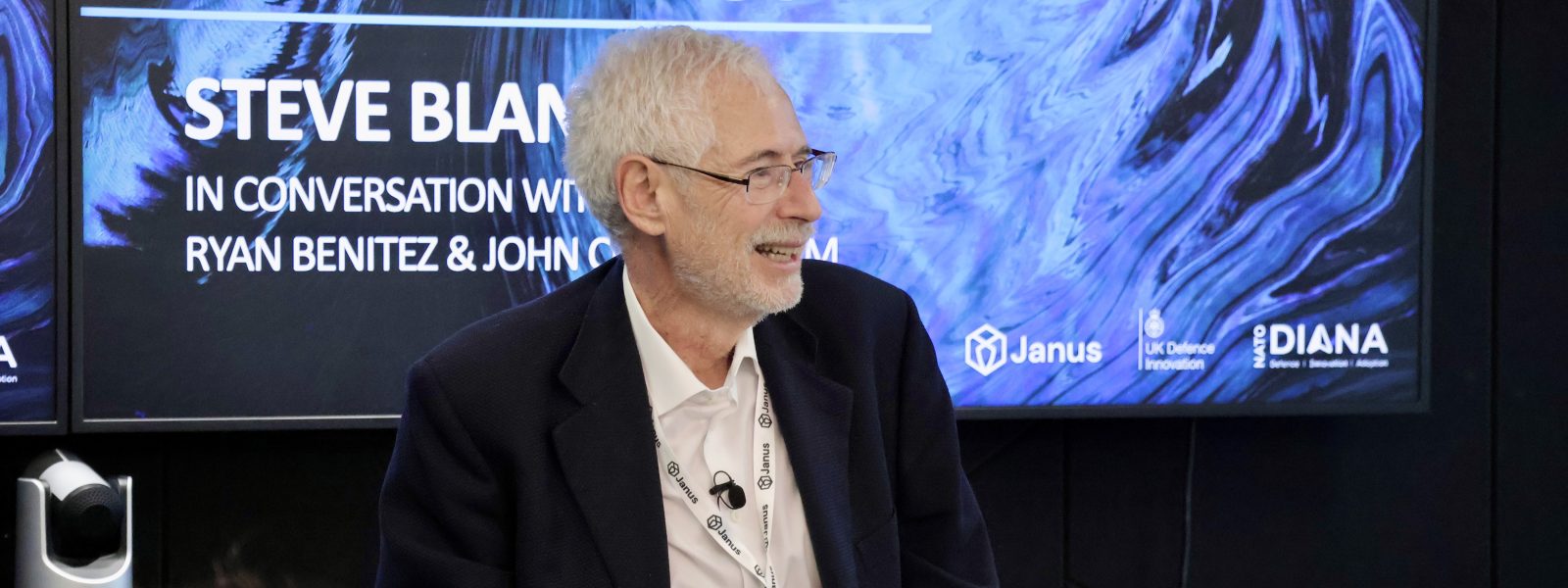
A few weeks ago I was working with entrepreneurs on the NATO DIANA programme, and I had one of those full circle days that reminds you how far you have come.
Steve Blank was in the room.
If you know entrepreneurship, you know why that might seem enthralling. His thinking has shaped the way many of us approach startups, customer discovery, and early-stage decision-making. I have returned to his work again and again in my own business and in the programmes I create for entrepreneurs.
I remember vividly the day his book “The StartUp Owners Manual” arrived in my life. I was temporarily living in a small apartment in Helsinki, and within 24 hours the floors were covered with A3 pieces of paper filled with sticky noted assumptions about my burgeoning startup.
It made me feel brave.
Actually, more than that, it made me feel excited to “get out of the building” and start testing the assumptions.
I had always put customers on a pedestal, what could my silly little ideas really do for them? Well now I had a clear methodology and a self-given mandate to find out, spurred on by the support provided in the book.
So, as you can imagine, I was interested not just in hearing him speak, but watching how he works with founders in practice.
Could I improve my entrepreneurial education by watching how he engaged with founders?
The first thing I noticed was the emphasis on nuance. Not buzz. Not bravado. Nuance.
That matters because so much of entrepreneurship gets lost in overblown slogans. Build fast. Launch faster. Ship and learn. Generic ideas, and incomplete ones.
Blank kept asking very specific questions that brought the conversation back to deep market understanding: delving into the specific part of the problem space that can create the most added value, helping companies frame questions which will guide them more quickly to figure out how to position their unique technology.
Through well-informed questions I witnessed several founders come into sharp focus.
The methodology alone cannot do the work, but it can give you a starting point, which, combined with the discipline to show up in the market every day, will start to move the business forward.
For me, this is also where the best entrepreneurial education becomes practical rather than performative. Founders do not need more abstract encouragement. They need a way of thinking that helps them test assumptions, sharpen their offer, and avoid mistaking enthusiasm for evidence.
That is the space I consistently try to work in.
How do you price your products and services
One of the most interesting parts of the day was hearing him speak about pricing.
Founders get very fixated on the pricing, they spend hours thinking about and trying to justify what the right price would be, often before they even know what is most valuable to a customer. But by talking to themselves, they are talking to the wrong people, and they are missing out on additional rich information.
In reality, pricing questions are one of the best ways to learn about the market.
The question is not only, How much should I charge?
When you are talking to potential customers you are beginning by trying to figure out where the real value lies, and you are using that to jump off into understand how you might actually engage with customer. You need to know so much more than just the price if you are going to sell.
Many founders will look at this and still think it feels impossible to have a pricing conversation. It’s not just a British thing to shy away from conversations about money, and I think that we sometimes make it too complicate. But the way Steve described it was very simple (I am paraphrasing)…
Founder: what if I were to charge you £1m to solve this problem?
Potential customer (looks a little shocked): that wouldn’t work because we tend to procure on a “per seat” basis
you now have new information
Founder (stays calm): Ah, I see, and how many seats might you want?
Potential customer: Well initially we would want to test it with a smaller group but we would want about 10k seats
you now have new information
Founder: So if we could do 100 dollars per seat would that be something that might work for you?
etc etc
All the while, this is done face to face so you can read body language, what is plausible and what isn’t. What is resonating with this potential customer?
Now, I know that this is an overly simplified version of how this conversation might go, and it is predicated on a few things. Most importantly you need to be confident that you have something of potential value to the customer and, of course, you need to have access to said customer.
It is easy for founders to think – its easy for him – he has access, if this conversation goes wrong he could find others, but if I speak to a customer I can’t “waste” that conversation.
And this is where the StartUp Owners Manual really helped me, the notion that customer discovery and customer development are part of the same thing. By going through an experimental process to “discover” the customer, you are actually building relationships and showcasing your credibility at the same time.
That is the kind of thinking I aim to embed in the entrepreneurs that I work with.
Do you buy into your own reality distortion field?
One thing I wanted to understand further was whether he thought there was a place for the founders who were struggling with belief in their business.
His answer was a pretty clear no!
Although I think there is some nuance to this which I will describe below.
He brought up Steve Jobs and the idea of a reality distortion field.
His answer was a good reminder that founders do need conviction. They do need to communicate with an inner knowing that they can make this a success. They do need to believe in what they are building, especially when the idea is not yet obvious to everyone else.
But conviction is not the same as fantasy.
The strongest founders I have seen are the ones who can hold both things at once: they are ambitious enough to push beyond what seems possible, and grounded enough to keep testing against reality. That balance is where trust is built.
That doesn’t mean that founders don’t waver in their belief sometimes, in fact, I think that it is a good sign, I don’t want tech business leaders who buy into their own BS, I want tech business leaders who can see their own excellence and build a vision that can bring that excellence to the world.
A reality distortion field is a powerful thing to wield, it needs to be used mindfully.
It is also why I think experience matters so much in entrepreneurial education. Not as a performance. Not as a list of job titles. Experience matters because founders are looking for guidance that is rigorous, specific, useful and most importantly tailored to the specific founder. You can tell when someone has lived through the visceral, sharp edge of entrepreneurship.
I also learned that I could see some nuance that goes beyond the lens of a man who has been successful in Silicon Valley for decades, the founders I work with aren’t necessarily Stanford grads (or drop outs), they aren’t always connected to the money or the influential business leaders. There is a lot more work to be done for founders who went to a state school in the UK, with no familial connections or role models, but I’m not writing them off and I know that my own experiences really help to cut through some of the barriers.
Will AI change it all?
We could not get through the day without talking about AI disruption.
One idea that struck me was the suggestion that agent outcome fit may become the new product market fit. Whether that exact phrasing becomes standard or not, the underlying point is hard to ignore: the tools are changing, and founders will need to think differently about how value is created and delivered.
But even in an AI-shaped market, the fundamentals still matter.
You still need to understand the user.
You still need to know the problem.
You still need to know what success looks like.
You still need judgment.
That is good news for educators, investors, and ecosystem builders. The tools may evolve quickly, but the need for strong thinking does not go away.
What I took from the day was simple.
The best entrepreneurial education is not about repeating fashionable ideas. It is about giving entrepreneurs well-informed support so they can be disciplined, courageous and judicious. Having a framework to anchor that support can help entrepreneurs to get out of their heads and get out of the building.
Written by
Dr Becky Sage
Entrepreneur in Residence, Leadership Facilitator, and Tech Ethics Advocate. Founder of Interactive Scientific, former Director of EDUCATE Ventures, host of Founded & Grounded.